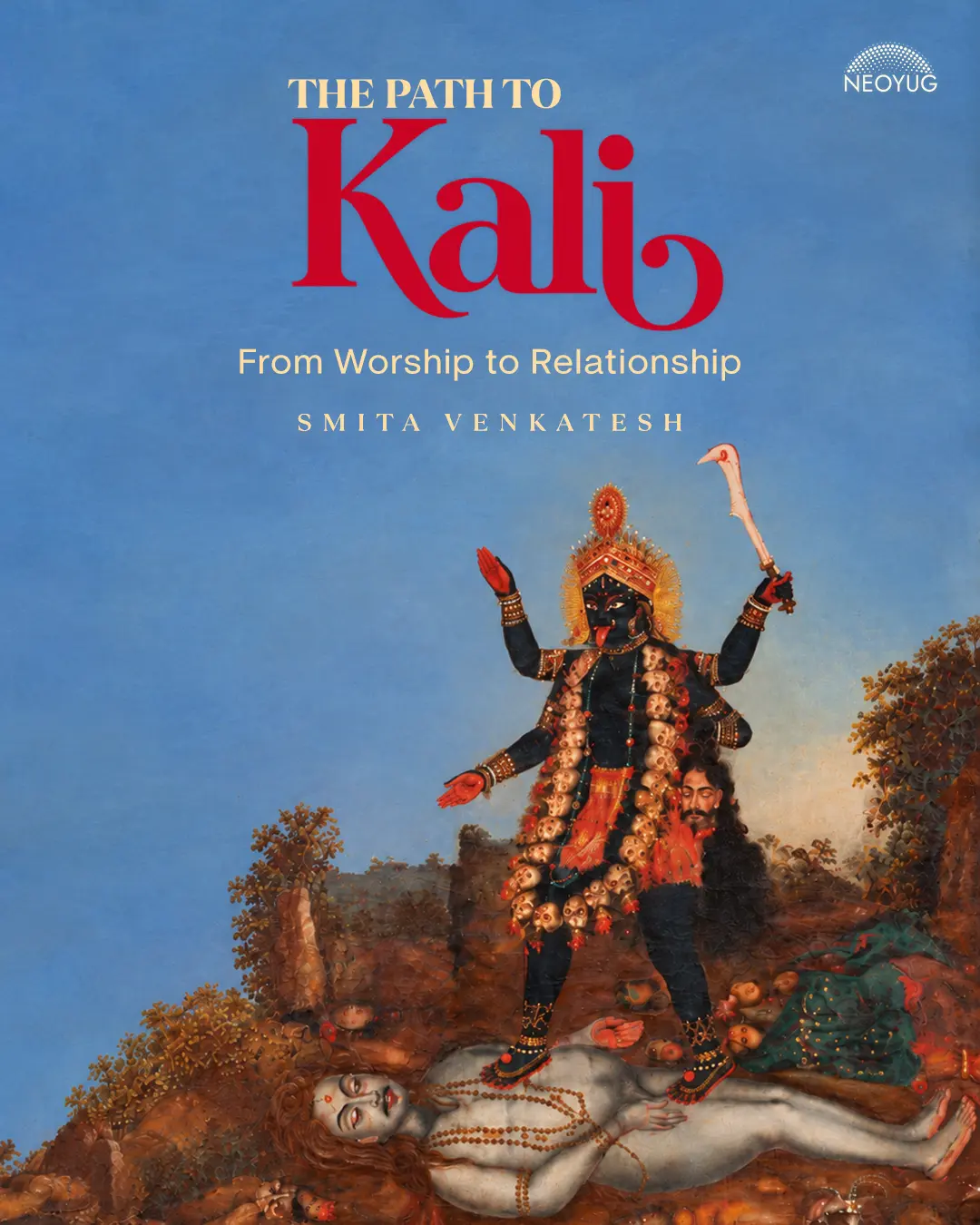
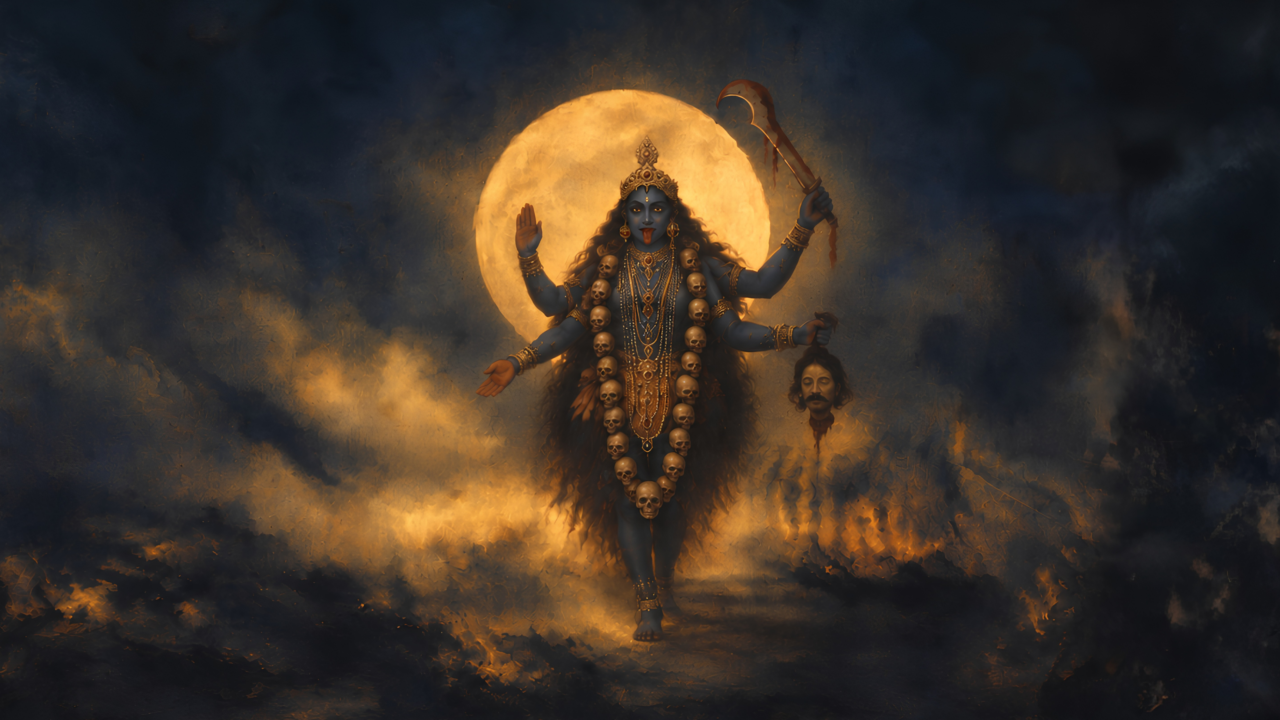
Most people meet Kali as an image long before they ever meet her as a presence. A dark form with a sword and a garland of heads, her tongue out, standing over Shiva. And almost immediately, someone tells us what to think. She is dangerous. She is fierce. She destroys. She is not for everyone, and she must be approached with great care. So we learn the posture. We fold our hands, light the diya, and stand at a respectful distance.
But what if distance was never the point? What if Kali was never asking to be admired from an altar, but asking to be known? That is where the path actually begins. Not with worship. With relationship.
Do we know how to relate to the Divine, or only how to worship it?
There is a difference between knowing the rituals around a deity and knowing the deity. You can know which flower to offer, which day to pray, which mantra to repeat, and still never ask the one question that changes everything. Who is Maa Kali to me?
The moment Kali stops being only an icon and becomes a relationship, her symbolism stops being decorative. Her sword begins to ask what in you needs to be cut. Her open hair asks where you have tied yourself down. Her darkness asks what you do when certainty disappears. Her abhaya hand asks what fear has been quietly governing your decisions. Her severed head asks which identity you are exhausted from carrying. Her cremation ground asks what you are still pretending is permanent.
This is where Kali becomes uncomfortable. Not because she is cruel, but because she is difficult to keep at a safe distance once you begin to understand her. This is also where the path really starts, seeing Kali beyond fear, myth and inherited interpretation, and meeting her as transformation, protection, truth and Mother.
Does understanding Kali make her any less fierce?
One of the biggest misunderstandings about Kali is the idea that spiritual closeness means making her soft. It does not. What changes is that you begin to understand what her fierceness is for.
Guru Maa Smita Venkatesh does not present Kali's fierceness as random violence. Her sword becomes a symbol of wisdom and discrimination. Her severed head points to false identification and mental restlessness. One raised hand says do not fear. The other blesses. She cuts and she protects. She destroys and she holds. That is why Kali is so hard to reduce to a single emotion.
She is the Mother who may refuse to preserve the very thing that is keeping you small. That is a very different kind of love, and it raises a harder question. What if some of the things you keep asking God to protect are the things keeping you trapped? That is the point where worship quietly turns into shadow work.
Are the demons in Kali's stories actually inside us?
Most people read the Devi's battles as ancient mythology. Madhu and Kaitabha, Raktabīja, the asuras, the weapons, the blood. Then the book closes and life resumes. But what happens when the story turns toward you? What if the demons are not only beings from another age, but patterns that quietly multiply inside ordinary people?
- Desire that hardens into compulsion
- Attachment that becomes dependency
- Praise that curdles into pride
- Fear that becomes paralysis
- Anger that goes underground and controls you from behind the scenes
- Jealousy you are ashamed to even admit
This is one of the most powerful shifts Guru Maa Smita Venkatesh offers. The inner battlefield is not used to call anyone bad. It is used to help you become conscious of what has been ruling you. And once you see Kali this way, the prayer changes. You stop asking whether Maa will remove the problem from your life, and you start asking what in you keeps feeding it. That is a far more dangerous prayer, because now you are not only asking for rescue. You are asking for truth.
What does a relationship with Kali look like in real life?
A relationship with Kali is not built only in incense and mantra. It shows up in your decisions. In the moments you say yes but mean no. When you stay silent so people keep liking you. When you call self-abandonment love. When you shrink your ambition because it makes someone else uncomfortable.
Kali's teaching becomes real exactly where spirituality usually becomes inconvenient. In relationships, in the body, in sexuality, in anger, in grief, in identity. In this journey, Guru Maa Smita Venkatesh frames this as the movement from destruction to Shakti. Real power is not control, loudness or aggression. It is staying connected to truth, acting without hatred, loving without disappearing, and saying no without becoming cruel.
That is what makes the path compelling. It is not about becoming more spiritual. It is about becoming less divided.
What am I still hiding from the Goddess?
Worship tends to ask what I can offer Maa. Relationship eventually asks what I am still hiding from her. This may be where Kali becomes most intimate, because many of us come to the Divine with edited versions of ourselves. The devoted self. The grateful self. The pure self.
But what about the rest? The jealous part, the angry part, the sexual part, the ashamed part, the part that is quietly angry with God. What happens if that part walks into the temple too? Kali is Digambara, uncovered, beyond artificial covering, and her form becomes an invitation to come without disguise.
So maybe the real question is not whether you are pure enough to approach Kali. Maybe it is whether you can stop pretending long enough to let her see you. That is where relationship begins, and it is also where you start to understand why the Goddess can seem to do nothing while you are suffering.
Why does Kali sādhana matter more than more spiritual information?
Understanding Kali can be powerful, but understanding alone changes very little if it stays in the head. You can hear a beautiful teaching at night and return to the same habits by morning. That is why sādhana matters. Guru Maa Smita Venkatesh describes sādhana as the bridge between what we understand and what we become, approached through preparation, repetition, observation, guidance and steady practice.
What is striking is that Kali sādhana is not presented as one dramatic ritual. It can begin with naam, with her name, with contemplating her form, with entering her stories, with stotra, japa or even silence. The journey also draws a clear line between accessible devotional practice and deeper Tantric methods that ask for guidance. That distinction matters, because spiritual intensity is not the same thing as spiritual depth. A secret mantra is not automatically more transformative than a simple name, and a complicated ritual is not automatically more powerful than ten honest minutes.
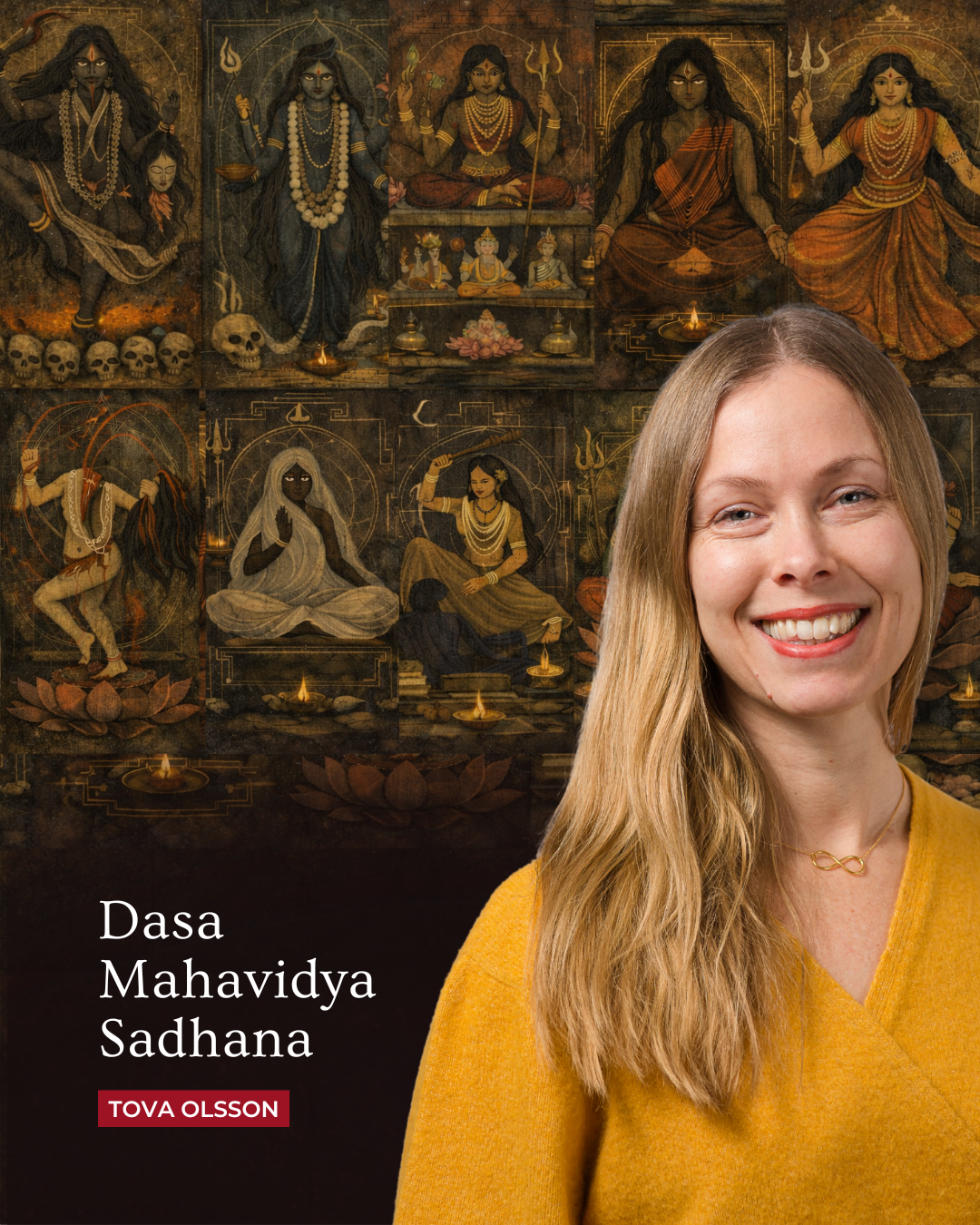
This is the architecture Guru Maa Smita Venkatesh walks you through in Maa Kali: Beyond Fear, Into Shakti, a five module progression that moves from understanding and inner work into Shakti, sādhana and the path itself. She brings more than thirty five years of Tantrik sādhana, Sri Vidya, Satvik Tantra and Daśa Mahāvidyā into the teaching, and her own relationship with Kali began young and deepened through guru, mantra and lived experience.
What happens when the chanting becomes listening?
There is a point where the practice goes deeper than do this mantra. Guru Maa Smita Venkatesh calls it the movement from japa to ajapa, and it asks a subtle question. What happens after the repetition ends? Can you stay? Can you listen? Can you let the mantra move from an activity into consciousness?
The mala brings you to the door. Silence allows you to enter.
That single line tells you what this journey is really about. Not collecting more words, but becoming available to what the words are trying to open.
Am I willing to let the relationship change me?
This is where many spiritual journeys quietly stop. People want comfort, protection, a blessing, a sign. But transformation asks for participation. In the final movement of the journey, the question becomes explicit. Am I willing to change, or do I only want Maa to change my circumstances?
That is a brutal question to answer honestly, because sometimes the suffering we want removed is tied to a habit we refuse to examine. A relationship we will not leave. A boundary we will not set. An identity we will not release. A fear we keep obeying. A need for validation we keep feeding.
This is why the path to Kali cannot end at worship. It has to become a relationship, and relationship eventually becomes surrender. Not the surrender of your dignity, but the surrender of what is false, of the performance, of the demand that life obey your fear.
So what does it actually mean to walk the path of Kali?
The real signs are far less dramatic than people expect. Are you more truthful? Less controlled by fear? More responsible with power? More compassionate without abandoning your boundaries? More able to return to yourself, to love without disappearing, to see where you are feeding your own suffering?
Guru Maa Smita Venkatesh frames the fruit of practice in exactly those terms. Not superiority, but truthfulness, responsibility, compassion and less fear. That is a far more serious path, and perhaps it is why Kali has always been misunderstood. She is not here to decorate your spiritual life. She is here to interrupt it.
If Kali has been calling you, the question may not be why. It may be how long you intend to keep standing in the doorway. You can keep knowing her through images, stories and fragments gathered online, or you can begin to understand the path itself, who she is, what she destroys, what Shakti she awakens, and how to walk with her with lineage, method and responsibility. The path is not about becoming worthy of Kali. It may begin the moment you stop standing so far away from her.