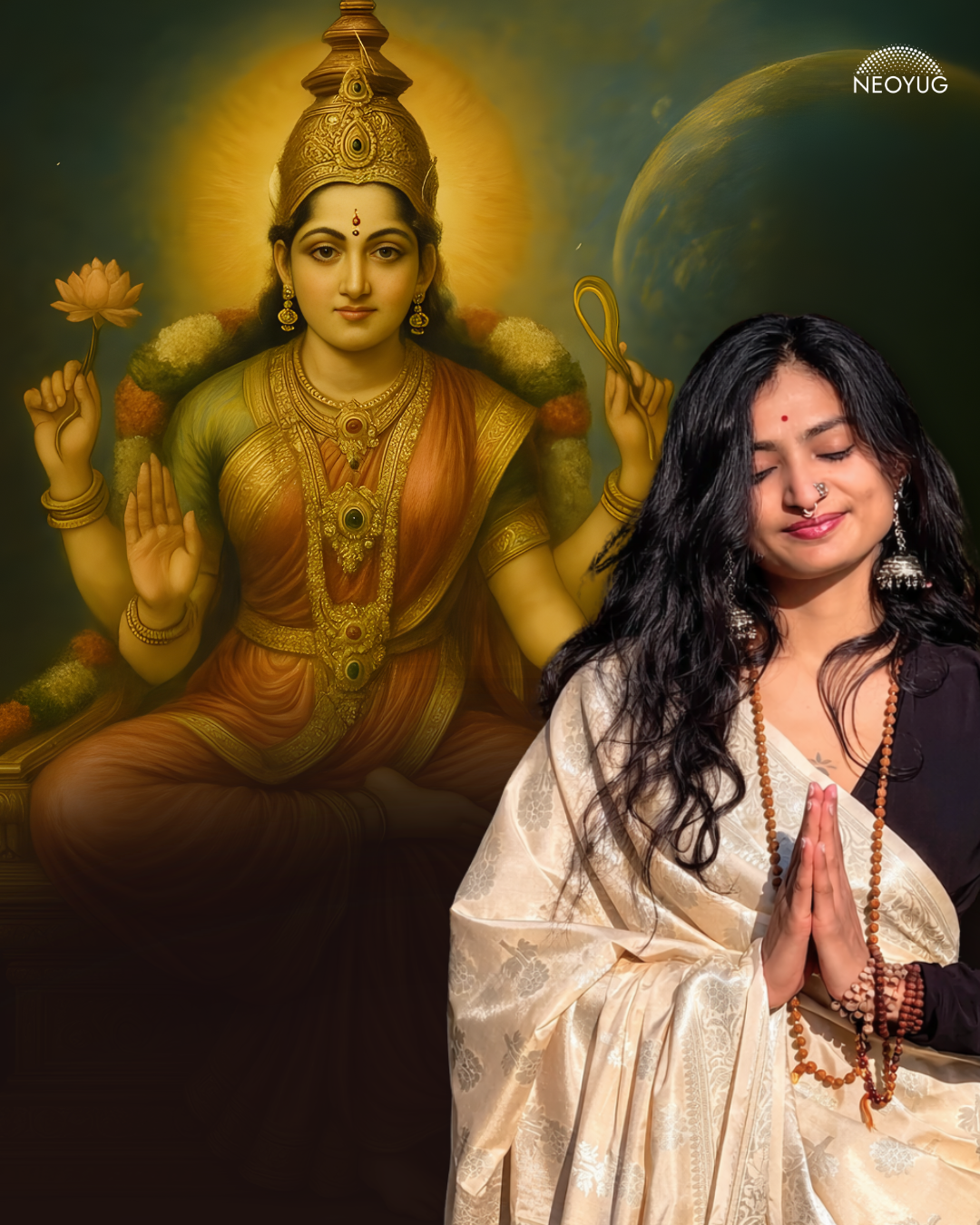
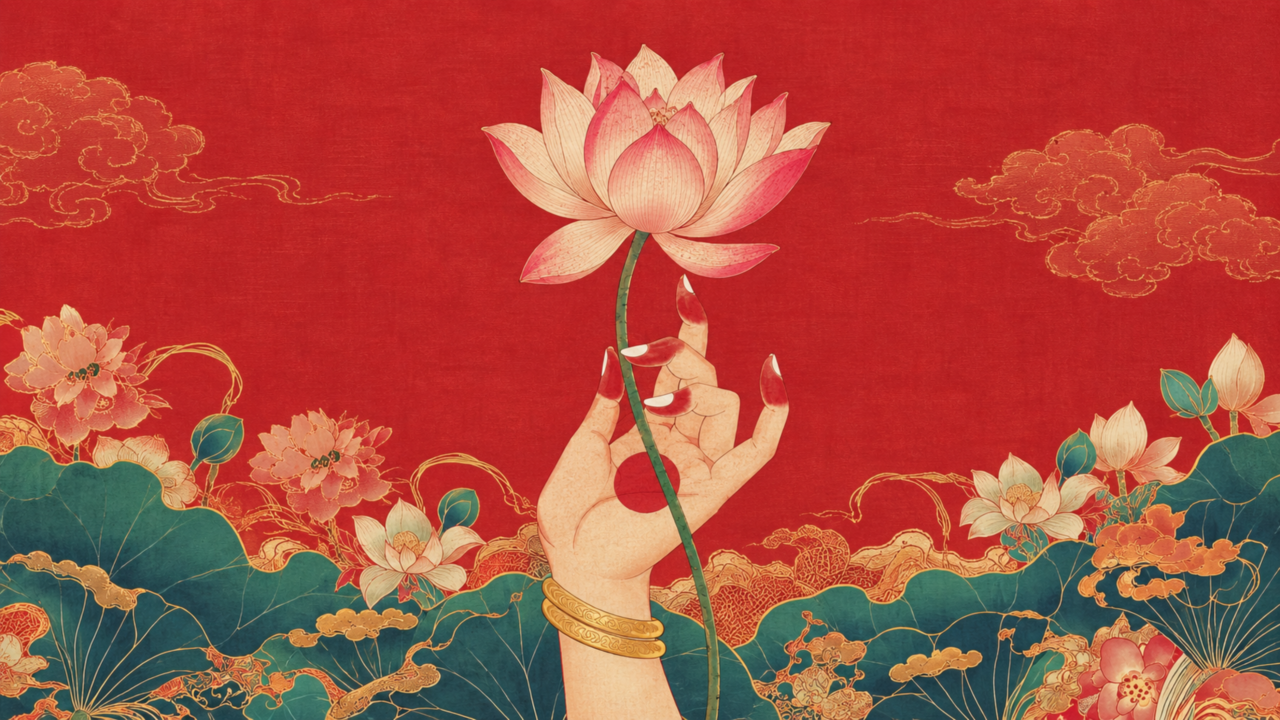
Every Navratri we are asked to worship the Goddess in her many forms. The girl. The ascetic. The one who marries. The one who creates. The mother. The warrior. The terrifying one. The luminous one. The one who stands beyond every name we have for her. We usually read this as a celebration of the feminine, a way of saying look how many kinds of power a woman can hold. But there is a stranger question sitting underneath the celebration, and it is the one worth staying with for nine nights.
Why does the sacred feminine have to pass through all of it? Why begin in innocence? Why undergo austerity? Why does desire enter the story at all, and then motherhood, and violence, and death? And why, after moving through every one of these identities, must she finally move beyond them? Navratri may be saying something far less comfortable than we assume about how power becomes whole.
Why Does Navratri Begin With A Girl?
The first night belongs to Shailaputri, the daughter of the mountain. She is usually treated as the gentle opening, the soft beginning before the real story starts. But where a tradition this deliberate chooses to begin is never an accident.
The feminine begins close to the earth, close to nature, close to a self that has not yet been divided into roles. She is not yet a wife. Not yet a mother. Not yet the protector of a household, not yet the fierce one who defends it. She simply is.
Perhaps that is the first thing the tradition is quietly protecting. Before the feminine becomes useful to anyone, she belongs to herself. Everything that follows across the nine nights rests on that one night of belonging to no one.
What Changes When The Girl Becomes An Ascetic?
The second form is Brahmacharini, and the atmosphere shifts completely. The girl becomes the ascetic. She walks. She waits. She practises austerity. She refuses immediate gratification for the sake of something further away.
This matters because innocence on its own is not power. Innocence is openness. Power asks for containment. The feminine here is not being asked to stay pure. She is being shown as capable of saying no. No to appetite, no to distraction, no to easy pleasure, no to what the world wants from her.
There is something quietly radical in that image. A culture that spends so much energy telling women what to desire eventually has to reckon with the woman who can refuse. Brahmacharini is not powerless because she has set sensuality aside. She is powerful because her desire belongs to her.
Can The Goddess Be Sensual And Sacred At Once?
With Chandraghanta the Goddess enters another dimension entirely. She is Parvati after her marriage to Shiva. The ascetic has entered relationship. The woman who once withdrew from the world is now fully embodied inside it. She wears the crescent moon. She is radiant, and she is armed.
Notice what the tradition does not say. It does not say be spiritual, therefore abandon desire. It does not say enter relationship, therefore give yourself away. It lets her carry both. She can be deeply relational without losing her centre. She can be beautiful without becoming only an object of beauty. She can be a wife without becoming only someone's wife.
This is where sensuality belongs in the sequence, as one more dimension of embodiment rather than a fall from grace. The body does not become less divine because it knows attraction, intimacy or pleasure. Renunciation is not the only road to the sacred. The Goddess can enter the world completely and still be the Goddess.
What Does The Goddess Create From That Fullness?
Then comes Kushmanda, associated with the cosmic womb and with the creative force from which existence itself emerges. The scale of the jump is astonishing. She does not simply create something. She becomes creation.
Tradition links Kushmanda with the cosmic egg, the universe unfolding through her. And with that, the question of the feminine becomes much larger than biological motherhood. Creation is the capacity to bring into existence something that was not here before. A world. A possibility. A life. A vision. A future.
Perhaps this is why she has to move from relationship into creation. Desire, once it is fully integrated, stops consuming and starts making. But whatever is created then has to be protected, and that is where the Goddess becomes mother.
Is The Mother Only Softness?
The fifth form is Skandamata, mother of Skanda, and now the Goddess holds a child. It would be easy to read this as the tradition saying women are nurturing. That reading is too small for what is happening here.
Skandamata is the feminine as the force that sustains what she has brought into being. Creation and protection stop being separate things. To make something is to become responsible for whether it survives, and that changes the nature of love itself.
Love is no longer only tenderness. Love grows boundaries. Love develops discernment. Love learns to say this must be protected. And the moment there is something worth protecting, there is also something you have to be willing to face.
What Happens When The Mother Picks Up Weapons?
Katyayani takes up weapons and rides into battle. She confronts the forces that threaten life and order. And suddenly the feminine is no longer permitted to be only beautiful, patient, nurturing, receptive. She becomes dangerous.
This is one of the most important disruptions in the whole sequence. Cultures generally know how to worship the feminine when she is gentle. The mother. The nurturer. The giver. The beautiful woman. But what happens when she is angry? When she refuses? When she fights? When she is no longer interested in being agreeable?
Katyayani answers plainly. She does not become less divine. She becomes another expression of the same Shakti. The weapons do not contradict motherhood, they come out of it. The force that creates and sustains life must also be able to destroy what threatens it. And here the Goddess becomes genuinely uncomfortable, because she is no longer asking to be loved. She is asking to be taken seriously.
Why Must The Goddess Enter Darkness And Death?
Then comes Kalaratri, and whatever comfortable picture we had been holding begins to come apart. She is dark, fierce, terrifying, bound up with destruction and fear and the night. She moves directly toward everything human beings instinctively avoid. Darkness. Loss. Death. The unknown.
This may be the most psychologically precise movement in the sequence, because there is a limit to empowerment. We can become stronger, more disciplined, more capable, more successful. We can learn to win our battles. And then we meet the one thing strength cannot negotiate with, which is mortality.
Kalaratri carries the feminine past the socially acceptable forms of power. She does not seduce. She does not nurture. She does not reassure. She terrifies, and the terror has a purpose, because anything we refuse to face eventually becomes the thing that runs us. She is the Goddess who walks into the darkness rather than pretending there is none.
She reminds us that destruction is not the opposite of creation but part of the same movement. What is born must change. What is made must dissolve. What we hold must eventually be released. The feminine passes through death because no identity survives forever, not even the identity of the warrior.
What Remains After The Fire?
And then Mahagauri, which after Kalaratri can feel almost startling. The terrifying dark gives way to extraordinary luminosity. It is tempting to read her as simply the pure Goddess in some moralistic sense, but that misses what has just happened to her.
Mahagauri is what remains after purification. After austerity, desire, creation, attachment, motherhood, battle and the confrontation with darkness, something has been burned away. What is left is clarity.
Purity here does not mean untouched. This Goddess has already lived, desired, created, loved and destroyed. It is not the innocence of someone who never met the world. It is the luminosity of someone who passed through it and is no longer imprisoned by it. Mahagauri is not innocence restored. She is innocence transformed.
Living the nine forms rather than reading about them is where Navratri Sadhana: From Devotion to Recognition begins, and the movement in its name is the one this sequence has been describing all along, from devotion to her forms toward recognition of what they are made of.
Why Does The Journey End Beyond Every Form?
Finally Siddhidatri, who grants the siddhis, associated with fulfilment, spiritual attainment and the completion of the nine nights. And with her something becomes clear. The journey was never really about becoming the perfect woman.
If it were, the sequence would end with the perfect composite: daughter, ascetic, wife, creator, mother, warrior and destroyer, all balanced in a single figure. Instead it ends by moving past identity altogether. The Goddess does not become whole by collecting more roles. She becomes whole by no longer being confined by any of them.
She was Shailaputri. She was Brahmacharini. She was Chandraghanta. She was Kushmanda. She was Skandamata. She was Katyayani. She was Kalaratri. She was Mahagauri. And she is not reducible to a single one of them. That is the point.
Is Navratri Telling Women Who To Become?
We often turn the Goddess into a template for womanhood. Be innocent. Be disciplined. Be beautiful. Create, nurture, protect. Be strong, be fierce, be spiritual. That is a strange conclusion to draw from a tradition whose central feminine figure refuses to stay one thing for more than a night.
Maybe Navratri is saying something else entirely. You are not one role. Every form may be true, and no single form is the whole truth. That is why she has to move through states that appear to contradict each other.
The moment anyone decides this is what a woman is, the Goddess changes form.
What Makes The Goddess More Radical Than Empowerment?
Empowerment, as we usually speak of it, asks how women can become powerful. The Goddess asks something more fundamental. Why did you assume power had only one appearance?
Why should power have to look masculine? Why must spirituality look detached from the body? Why must motherhood be passive? Why must sensuality be impure? Why must anger make a woman less feminine? Why must destruction be unfeminine? Why must purity mean never having met darkness? Why must the sacred be comfortable?
She refuses every one of those neat divisions. Untouched and embodied. Desiring and disciplined. Nurturing and violent. Beautiful and terrifying. Creative and destructive. Mother and warrior. Humanly recognisable in one moment and completely beyond comprehension in the next.
Why Does It Take Nine Nights?
Because the Goddess cannot be held in a single image. It takes nine nights to move through her, and even then the journey does not really close.
- It begins with the daughter who simply is.
- It moves through the woman who learns to choose.
- The woman who enters relationship.
- The force that creates.
- The mother who protects.
- The warrior who fights.
- The darkness that destroys.
- The luminosity that remains.
- And the presence that transcends every name we gave her along the way.
And then, mysteriously, it begins again. That may be the deeper mystery of Navratri. The feminine becomes sacred when we stop demanding that she stay only one thing, because life itself is not one thing and never was. Form by form, night by night, she keeps revealing something we keep forgetting.
She was never only one thing to begin with.