
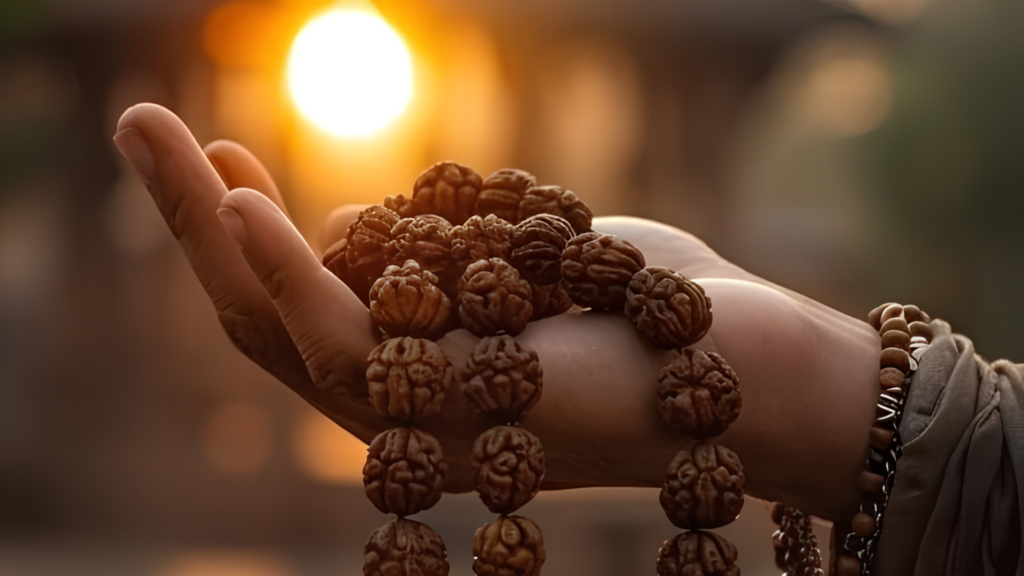
Two kinds of prayer
There are prayers we recite because we want something from God. And then there are prayers that slowly change the person who is praying. Sri Rudram belongs to the second kind.
You don't need to know Sanskrit to encounter its power. You don't need to already be a Shaiva. You don't need years of practice behind you. But you do need a willingness to meet something profound: the possibility that the Divine is not only present in what we consider beautiful, peaceful and sacred. It is also present in what frightens us, in uncertainty, destruction and endings, in disease and healing.
Sri Rudram does something remarkable. It does not ask you to divide life into the things you want and the things you don't. It teaches you to recognise Rudra everywhere. And that changes the way you stand inside your own life.
So what exactly is Sri Rudram?
If you have never encountered it before, the name itself can sound intimidating. Sri Rudram is one of the most revered Vedic hymns dedicated to Rudra, a powerful and complex form of Shiva. It occurs in the Taittiriya Samhita of the Krishna Yajurveda, traditionally identified as the fifth section of the fourth Kanda. It is commonly experienced through two closely connected portions:
- Namakam, the section characterised by repeated salutations to Rudra.
- Chamakam, the section that asks, through the repeated invocation cha me ("and may there be for me"), for a vast spectrum of qualities, capacities and forms of wellbeing.
Together, they form what many practitioners simply call Sri Rudram. At first glance, you may think you are simply listening to an ancient prayer to Shiva. But stay with it longer, and another possibility emerges. Sri Rudram is a radical education in how to relate to reality.
Who is Rudra?
This is perhaps the first thing we need to understand. If your idea of Shiva is only the peaceful yogi sitting in meditation, Sri Rudram may surprise you.
Rudra is fierce. But fierce does not mean evil. Rudra represents a force that can shake, dissolve, purify and transform. The very name is traditionally connected with ideas of crying, roaring and fierce force. Yet the hymn does not simply reject this fierceness. It bows to it. Again and again. And this is one of its deepest teachings.
What if the force you are trying to escape is sometimes the force that is breaking open what can no longer remain?
A relationship ends, or an identity collapses, or a career changes. Something you thought would last suddenly doesn't. The first human response is often, "Why is this happening to me?" Sri Rudram offers another posture: can I meet what is happening without immediately turning it into an enemy? That is a very different kind of spirituality.
The astonishing thing about Namakam
The first major section, Namakam, repeatedly offers salutations to Rudra in his many manifestations. And the range is extraordinary.
Rudra is recognised in what is familiar and unfamiliar, cultivated and wild, elevated and ordinary. The hymn's vision does not keep the Divine safely inside the temple. It takes the Divine into the world, into forests, mountains, people, occupations, the visible and the invisible, the beautiful and the unsettling.
And suddenly the spiritual question becomes much bigger: what if there is nowhere you can go where the Divine is absent?
Where Sri Rudram becomes deeply psychological
Think about your own life. You probably have parts of yourself you are proud of. And then there are the parts you would rather hide. Most of us build an identity around the first category and try to exile the second. We say, "This isn't me."
But what we reject doesn't necessarily disappear. It often moves underground. It becomes the part of ourselves we don't understand.
Sri Rudram offers a radically different spiritual imagination. It repeatedly expands the field of where Rudra can be recognised. And, metaphorically speaking, this gives us a powerful invitation: stop building your spirituality around the parts of yourself you approve of. Learn to meet the whole human being.
Rudra is not the destroyer of your life
This is where fear-based interpretations can do real damage. People sometimes approach fierce forms of Shiva through anxiety:
- "Will something bad happen if I chant this incorrectly?"
- "Is Rudra dangerous?"
- "Can this invocation attract negative energies?"
These questions often arise when sacred traditions are stripped of context and turned into superstition. The deeper Vedic vision is much more expansive. Rudra's fierceness can be understood as the force that breaks through what is false, stagnant or no longer sustainable. Destruction is not always punishment. Sometimes destruction is transformation.
A seed has to break. A season has to end. An old identity has to loosen. The ego often experiences this as loss. Life may experience it as renewal.
And then comes Chamakam
If Namakam teaches us to bow, Chamakam introduces another dimension. It repeatedly invokes cha me, traditionally understood as "and may there be for me." And what follows is remarkably expansive.
The prayer does not ask only for abstract spiritual enlightenment. It encompasses nourishment, vitality, strength, intelligence, wellbeing, capacities, resources and many dimensions of a flourishing human life. This matters.
Indian spirituality is sometimes incorrectly presented as an attempt to escape life. Sri Rudram doesn't present such a simple picture. There is room for renunciation and fullness, for inner freedom and outer wellbeing, transcendence and embodiment, spiritual and material. The implication is beautiful:
You do not have to hate life in order to transcend your attachment to it.
You can participate in life fully without believing that your possessions, achievements or identities are the entirety of who you are.
So what can Sri Rudram actually transform?
Let's be careful here. Sri Rudram is not a magical formula that guarantees wealth, cures illness or makes difficult circumstances disappear. Those kinds of promises reduce a profound Vedic tradition into transaction.
Traditionally, Sri Rudram has been associated with prayer, purification, wellbeing, protection, spiritual discipline and devotion to Rudra. But the transformation a practitioner experiences also depends on how the practice is approached. If you approach it as, "I will chant this and God will fix my life," you may miss the deeper invitation. If you approach it as, "I am willing to become more capable of meeting life consciously," the practice becomes something else entirely. It can become a discipline of:
- Steadiness. Learning to remain present when circumstances become uncertain.
- Humility. Remembering that life is larger than the individual ego.
- Courage. Developing the capacity to meet what you would rather avoid.
- Acceptance. Not confusing acceptance with passivity, but learning to see reality before deciding how to respond.
- Inner purification. Observing the patterns, attachments and identities that keep repeating within you.
- Devotion. Moving from trying to control everything toward a deeper relationship with something greater than yourself.
- Integration. Learning that spirituality does not require you to reject your humanity.
Your life is not divided into sacred and ordinary
Imagine washing dishes. Going to work. Having an argument with your partner. Holding your child. Making money. Our minds create categories:
- spiritual or unspiritual
- good or bad
- pure or impure
- success or failure
But the Rudra vision continually disrupts these rigid divisions. It asks us to recognise the sacred presence throughout existence. And perhaps that is one reason Sri Rudram has remained alive for centuries. It doesn't only speak to people sitting peacefully in temples. It speaks to human beings living inside an unpredictable world.
But Sri Rudram is also a discipline
It is easy to romanticise Vedic chanting. Beautiful sound, powerful Sanskrit, ancient vibrations. But Sri Rudram is not merely something to put on in the background while doing something else. Traditional Vedic recitation is a disciplined oral tradition.
Pronunciation matters. Accent and intonation matter. Rhythm matters. And the traditional transmission of Vedic chanting involves learning carefully from someone trained in the tradition.
This doesn't mean you need to be a Sanskrit scholar before you can approach Sri Rudram. It means you should approach it with respect rather than casualness. You can begin by listening. Learn the meaning. Understand the structure. Develop familiarity with the pronunciation. And if you wish to undertake regular recitation, learn from a competent teacher or an established Vedic chanting tradition.
The point isn't perfection on day one. The point is reverence, attention and consistency.
What does it take to practise Sri Rudram?
It takes something much simpler:
- Time. You have to make room for the practice.
- Attention. You have to actually listen.
- Discipline. You have to return even when the initial excitement disappears.
- Correct learning. You need to respect the integrity of the chant.
- Understanding. Knowing what you are reciting can transform your relationship with the words.
- Humility. You are approaching a tradition that has survived through generations of practitioners.
And perhaps most importantly, a willingness to be changed. Because the deepest spiritual practices aren't designed merely to give you experiences. They are designed to change the person who is having them.
What if you stopped asking what Sri Rudram will give you?
Instead of asking, "What will Sri Rudram give me?" you might ask, "What kind of person can I become through relating to Rudra?" That question changes everything. Perhaps you become less frightened by change. Perhaps you stop interpreting every ending as punishment. Perhaps you become more capable of sitting with uncertainty.
Sometimes strength is the capacity to remain present while something is being transformed. And perhaps that is the true power of Rudra. Not that he removes everything difficult from your path, but that, through devotion and practice, you become more capable of walking the path.
Sri Rudram asks you to make peace with the full spectrum of existence
There is a profound maturity in that. To bow to the storm without becoming the storm. To honour destruction without becoming destructive. To experience grief without believing that grief is your identity. It is a different kind of power: the power to remain open to life.
Perhaps Rudra is closer than you think
You may never have memorised a single verse of Sri Rudram. You may never have considered yourself a spiritual person. And yet you have already met Rudra in some form. You have met him in the moment life forced you to change. In the ending you didn't choose. In the truth you didn't want to hear. In the courage you discovered only because you had no choice but to find it.
And perhaps this is why Sri Rudram continues to speak. Because human beings continue to face the same fundamental mystery: how do I remain whole in a world that is constantly changing? Sri Rudram doesn't give a simplistic answer. It gives you a way of standing, seeing, bowing, asking. A way of meeting the immense mystery of existence.
And perhaps, eventually, a way of realising: Rudra was never only the force outside you. The capacity to transform was within you too. The courage was within you. The awareness was within you. The power to let go was within you. And the ability to begin again was always within you.
 Google