
What Tantra Has Always Been
For many people today, the word Tantra provokes one of two reactions. It is either romanticised into mysticism and spectacle, or misunderstood as something secretive, forbidden, or dangerous.
Very rarely is Tantra understood for what it has always been: a sophisticated spiritual tradition concerned with one question above all others. How does a human being awaken to their true nature while fully participating in life?
Among the many streams of Tantra that have evolved over centuries, Vama Trika Tantra occupies a unique place. It is subtle, demanding, deeply symbolic, and rooted in a radical insight.
Nothing in existence is outside the Divine.
Where many spiritual paths begin by asking us to renounce, Vama Trika asks us first to understand.
What Does Vama Trika Mean?
The word Vama carries several meanings in the Sanskrit tradition. It has been interpreted as left, but also as beautiful, graceful, and that which belongs to Shakti. It points toward a way of seeing reality that refuses simplistic divisions between the sacred and the ordinary.
Trika means the triad. Within the Kashmir Shaiva tradition, Trika refers to the inseparable unity of:
- Shiva, pure consciousness
- Shakti, dynamic creative power
- The individual, who gradually recognises their identity with both
Rather than viewing the world as something to escape, Trika philosophy sees existence itself as the living expression of consciousness. The goal is not becoming someone else. The goal is recognising what has always been true.
The World Is Not the Problem
One of the most revolutionary insights of Tantra is this: the problem is rarely the world. The problem is our unconscious relationship with it.
Fear itself is not bondage. Unconscious fear is. Desire itself is not bondage. Unexamined desire is. Power itself is not dangerous. Unconscious power is.
Tantra therefore does not begin by asking us to suppress experience. It asks us to become intimate with it. To observe. To understand. To transform.
Why Symbols Matter in Tantra
Tantra communicates through symbolism. A deity is never merely a figure to be worshipped. A deity is also a map of consciousness. This is why Tantric texts are filled with imagery that can appear paradoxical.
What looks shocking on the surface often points toward profound psychological and spiritual truths. Without context, symbols are easily misunderstood. With guidance, they become transformative.
Vama Trika Is Not About Breaking Rules
Popular culture often portrays Tantra as rebellion. Historically, the intention was far more nuanced.
Certain Tantric traditions challenged rigid ideas about purity and impurity, not to encourage recklessness, but to expose how deeply conditioned the human mind can become. When we automatically divide life into acceptable and unacceptable, sacred and profane, we often stop seeing clearly.
Tantric inquiry asks: what if the deepest freedom comes not from rejecting parts of existence, but from understanding them without fear?
This does not remove ethics or responsibility. If anything, it requires even greater maturity, because freedom without awareness is not liberation. It is simply impulse.
The Three Forces of Transformation
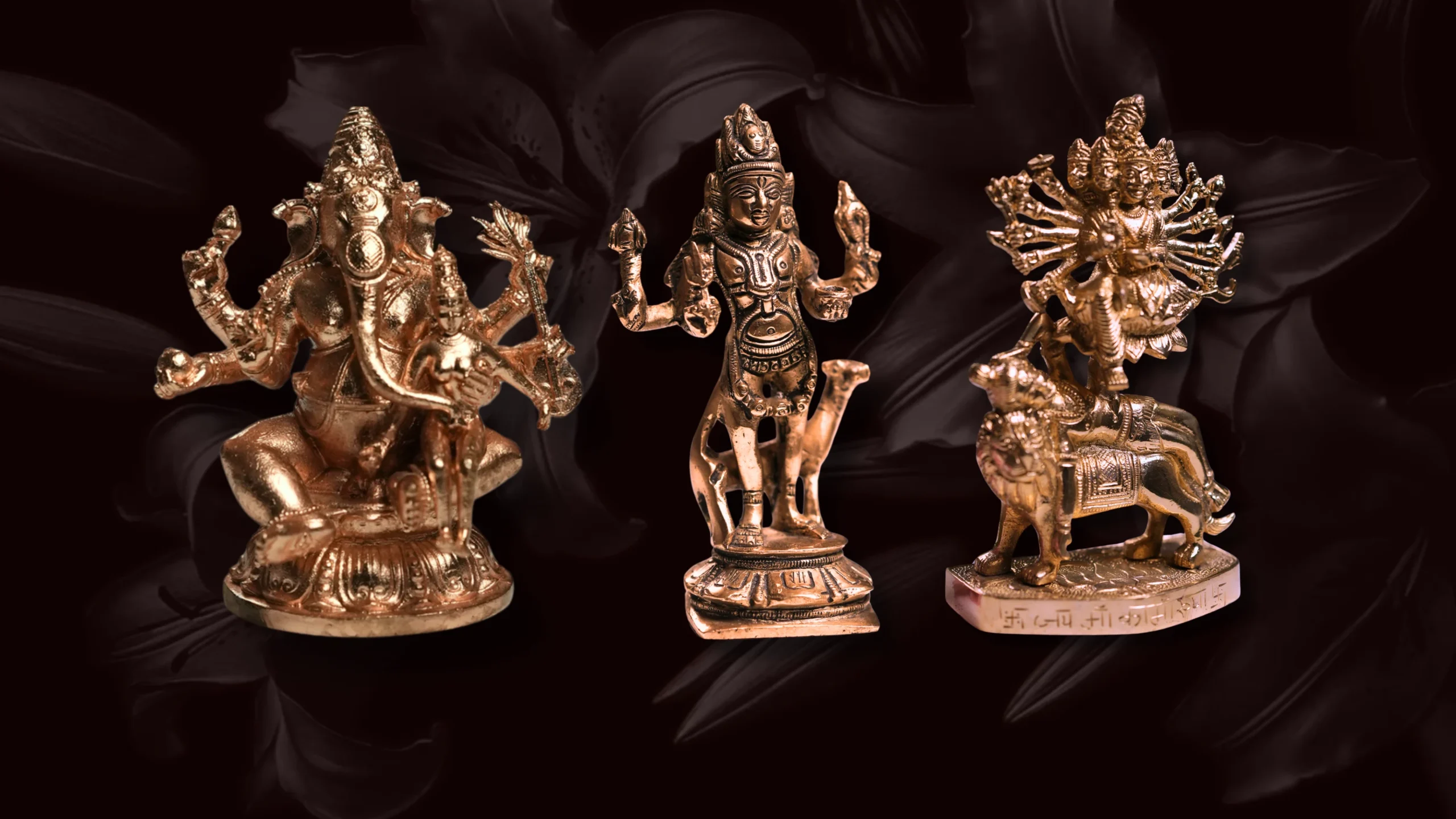
Many Vama Trika lineages work with different deities, each representing a distinct movement in inner transformation. While traditions vary, these archetypal principles are often contemplated together, because they illuminate complementary aspects of the same journey.
Ucchishta Ganapati
Ucchishta Ganapati is one of the least understood forms of Ganesha. He invites the practitioner to examine everything they have rejected, hidden, or considered unworthy. What is discarded externally often mirrors what has been discarded internally.
The teaching is not about celebrating disorder. It is about recognising that transformation begins where rejection ends.
Bhairava
Bhairava is frequently associated with fearlessness, but his teaching goes deeper. He represents unwavering awareness in the midst of impermanence.
Where the ordinary mind contracts in uncertainty, Bhairava invites presence. Not because life becomes easier, but because consciousness becomes steadier.
Kamakhya
Kamakhya is one of the most revered manifestations of the Divine Feminine in the Tantric tradition. She reminds us that creation itself is sacred. Life does not unfold despite the body. It unfolds through it.
Kamakhya therefore becomes a profound invitation to honour embodiment, creativity, intuition, and the generative intelligence of existence itself.
Transformation Is Not About Becoming Someone Else
Many people approach spirituality hoping to erase uncomfortable emotions. Tantra offers another possibility.
Instead of asking, how do I stop feeling this, it asks, what is this experience trying to reveal?
The difference is enormous. One seeks avoidance. The other seeks understanding. This shift alone can change the entire direction of a spiritual practice.
Why Guidance Matters
Tantric traditions have historically been transmitted through living teachers and lineages, because experience cannot always be understood through books alone.
Symbols require interpretation. Practices require preparation. Context protects both the tradition and the practitioner. This is why serious teachers consistently emphasise humility, discernment, and responsibility over sensationalism.
Depth is never created by rushing.
Tantra Is Not Separate From Daily Life
One of the greatest misunderstandings about Tantra is that it belongs only inside temples, rituals, or esoteric circles. Its real test is far simpler.
- Can awareness remain present during conflict?
- Can compassion remain present during disappointment?
- Can clarity remain present during success?
- Can freedom remain present even when life changes unexpectedly?
If not, the work continues. Tantra is ultimately measured not by extraordinary experiences, but by ordinary moments lived differently.
The Invitation of Vama Trika
Perhaps the deepest teaching of Vama Trika Tantra is not that the world needs to be escaped, nor that every experience must be embraced uncritically. Rather, it is the invitation to meet life with such awareness that nothing remains merely unconscious.
When fear is seen clearly, it becomes wisdom. When desire is understood deeply, it becomes energy. When power is held responsibly, it becomes service. When the ordinary is recognised as sacred, spirituality ceases to be an activity. It becomes a way of living.
Vama Trika Tantra offers something far more enduring: the possibility of becoming intimate with reality exactly as it is, and discovering that awakening is not found by turning away from life, but by meeting it with awareness, reverence, and responsibility.
A Note on Tradition
Vama Trika Tantra encompasses diverse lineages and interpretations. Practices, initiations, and methods differ between traditions and are traditionally undertaken under qualified guidance. This article is intended as an introduction to the philosophy and spirit of the tradition, not as instruction in Tantric practice.
 Google