
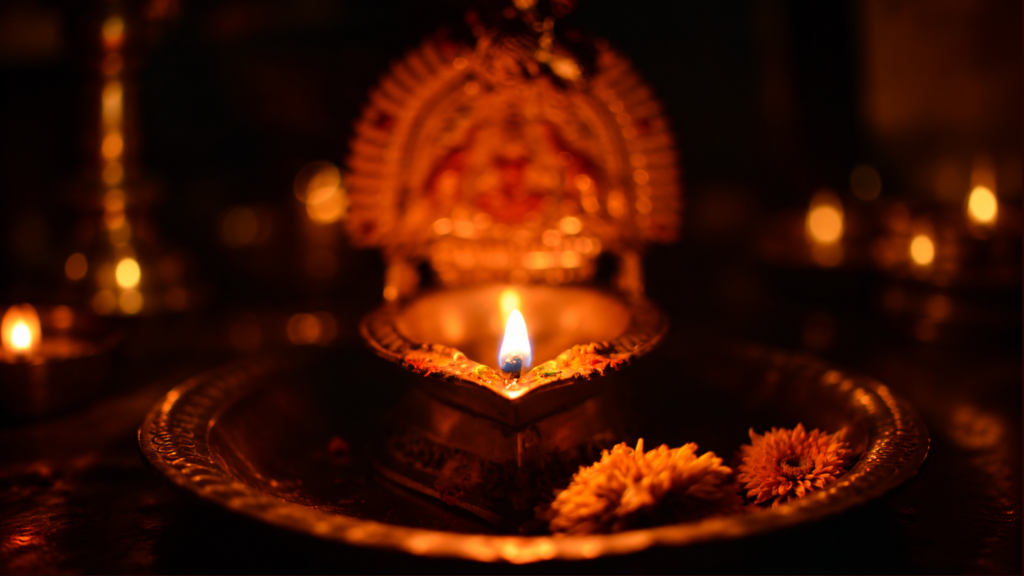
There is something unusual about the Indian way of looking at the dead. A person may leave the visible world, but their place in the life of those who remain is not treated as erased. Their name is still spoken, water is still offered, food is still prepared in their remembrance.
During Pitru Paksha, families pause their ordinary lives to remember those who came before them. To a modern mind this can seem strange. Why offer food to someone who is no longer physically here? Why remember ancestors you may never have met? The answer is deeper than the fear of skipping a ritual. The tradition is asking us to remember something modern individualism makes very easy to forget: your life did not begin with you.
What is Shraddha, and what does the word actually mean?
Shraddha is the rite through which descendants make offerings to those who came before them. The word itself comes from shraddha, meaning faith, trust and reverence. That matters, because the ritual is not named after fear. It is named after faith.
The emotional posture it asks for is not "what if something terrible happens to me?" It is closer to "I remember. I acknowledge. I offer." That difference has become important in a culture where ancestral practices are often presented as warnings.
Why do the scriptures treat the ancestors as a duty rather than a danger?
Because the language they use is the language of relationship, not threat. The Taittiriya Upanishad, in its famous instruction to the departing student, says devapitrikaryabhyam na pramaditavyam: do not neglect your duties toward the gods and the Pitrus.
Notice what it does not say. It does not say your ancestors will punish you, or that they are waiting to be appeased. It says do not neglect your obligations toward them. That is the vocabulary of responsibility and gratitude.
matridevo bhava, pitridevo bhava. Let your mother be one whom you regard as divine. Let your father be one whom you regard as divine.
Who are the Pitrus?
Pitru is usually translated as ancestor or forefather, but the traditional idea is more textured than "dead relative". The Pitrus belong to a larger sacred understanding of ancestry and of the generations that made this one possible.
They are also remembered specifically rather than as an anonymous category called the dead. Father, grandfather, great grandfather, mother, grandmother, relatives, friends. Remembrance through the name keeps the ritual intimate. These were people with a voice, a place at a table, and an existence that altered someone else's life, and eventually yours. Some traditions hold that this inheritance settles into a family deity carried down the line.
What does the Mahabharata say about Shraddha?
It says a great deal. The Anushasana Parva contains extended conversations between Yudhishthira and Bhishma about Shraddha and the Pitrus, describing offerings of water and food, and remembrance of ancestors by name across three generations.
One detail is especially beautiful. When a person comes upon a river, water may be offered to the Pitrus there, first to one's own ancestors and then to departed friends and relatives. The dead are not remembered only inside a designated ritual space. Their memory can accompany the living through the world, and a journey through the landscape becomes a chance to acknowledge the journeys that came before.
Does the Bhagavad Gita acknowledge ancestral worship?
Yes, explicitly. Verse 9.25 says yanti devavrata devan, pitrin yanti pitrivratah: those devoted to the gods go to the gods, those devoted to the Pitrus go to the Pitrus.
It places devotion to the ancestors within a wider religious landscape rather than pretending it does not exist. At the same time, Krishna sets different forms of worship within a hierarchy of orientation. So we should be careful: the Gita acknowledging Pitru worship does not mean every later belief about ancestors can be attributed to the Gita.
What is pitru-rina, the debt to the ancestors?
The Taittiriya Samhita speaks of three debts that arrive with birth: rishi-rina, the debt to the seers, deva-rina, the debt to the divine powers, and pitru-rina, the debt to the ancestors. We arrive already indebted, not because we have done wrong, but because we have received before we were capable of giving anything back.
That reverses the modern question. We tend to ask what life owes us. The older question is what we have already received, and therefore what we will do with it.
Does honouring your ancestors mean approving of everything they did?
No. Remembering someone does not require declaring everything they did to be right. You can honour the fact that life came through a person without repeating every pattern they carried.
If your ancestors were loving, remembrance becomes gratitude. If they were flawed, it becomes honest recognition. If there was trauma, it need not mean glorifying it. It may mean saying: this came through my lineage, and it ends differently with me. Remembering is not the same as repeating, and much of what we carry works like an agreement nobody remembers signing.
Where did the fear around Pitru-dosha come from?
From centuries of accumulation around the rites: regional customs, Dharmashastra literature, Puranic narrative and local practice. The textual tradition is diverse, and it should not be collapsed into one doctrine called "what Hinduism says".
Many modern claims also go further than the scriptures do. That skipping Shraddha will certainly bring a curse. That every difficulty with marriage, fertility, money or health is necessarily caused by Pitru-dosha. The presence of ancestral rites in scripture is one thing. Turning every misfortune into evidence of ancestral displeasure is another. Once remembrance becomes fear, something beautiful is lost.
What is the ritual actually asking of you?
Attention. The Mahabharata's discussion of Shraddha returns again and again to care, concentration and proper observance. The rite is not only about doing the correct thing so that nothing bad happens. It is about how you remember.
This is consistent with a much wider Indian understanding of ritual: the outer act is never entirely separate from the inner disposition with which it is performed. Learning to hold that attention is the whole of the work in Empowered By Ancestors.
Why does forgetting the dead matter?
Because forgetting creates the illusion that we made ourselves. Imagine someone who believes they did. The tradition quietly asks: did you invent your language, create your body, discover every piece of knowledge you hold, build every road you travelled, raise yourself?
We are all standing somewhere, and beneath that somewhere are layers of other people's lives. Some known, most unknown. The ancestor is not only the face in the photograph. The ancestor represents a deeper truth: there was a world before you, and you are one moment in a much longer story.
What do you inherit besides blood?
A great deal more than genes. There is a lineage of knowledge, of teachers, of practice, of family, culture, craft and memory. You inherit unfinished stories, habits, names, values, possibilities. Sometimes you inherit wounds.
- A body, a language, a name and a place to begin
- Ways of making a living, and ways of understanding the world
- Stories, food, ritual and the shape of a family
- Patterns nobody chose, and some nobody named
The responsibility of the living is not to preserve all of it unchanged. It is to discern what deserves continuation. That is where remembrance becomes an ethical act rather than a nostalgic one.
One day you will become someone's ancestor
Right now you may think of yourself as someone's child. You are also part of someone's past. If your life continues into another generation, you become part of a world someone else inherits.
Someone may speak your name, wonder what you believed, live with the consequences of choices you made. So ancestral remembrance does not only ask what we owe the dead. It asks what we are leaving for those who come after us, which is a more uncomfortable question, and a more useful one.
So why do the scriptures ask us to remember?
Because the living need to remember what they have received. The Upanishads tell us not to neglect our duties toward the Pitrus. The Gita acknowledges devotion directed toward them. The Mahabharata gives Shraddha substantial teaching. The Vedic tradition names pitru-rina, the obligation that arises because we receive life before we can give anything back.
Together they point toward a worldview in which a human being is a participant in a continuum rather than an isolated beginning. You came from somewhere. You were carried by lives you did not create. And something of you will pass onward too. Remembrance says: I know I did not begin the story. Gratitude says: I will be careful with the chapter I have been given.
 Google