
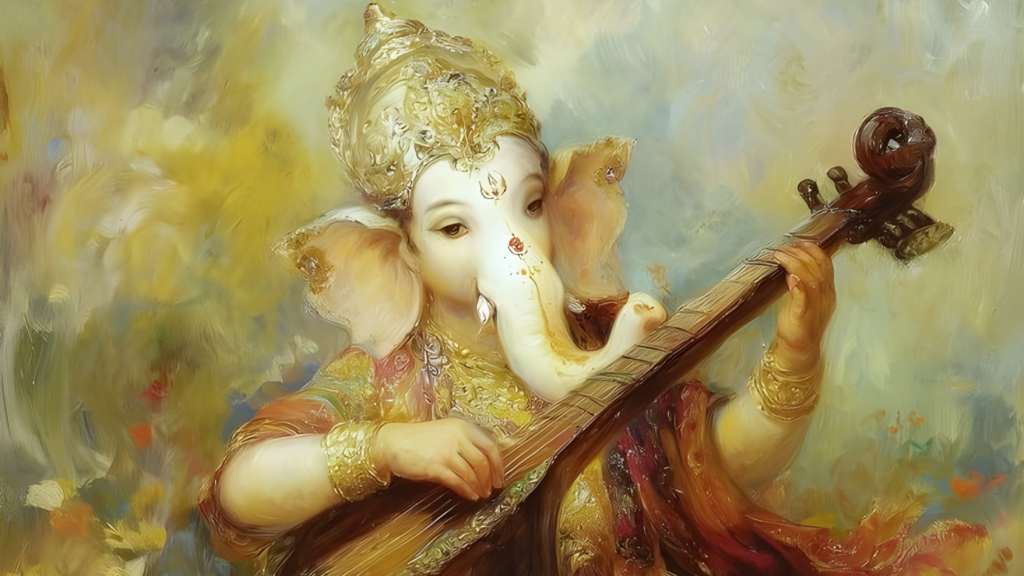
The forgotten asuras of the Mudgala Purana, and the inner war hidden inside the stories of Ganapati.
Most people know Ganesha as Vighnaharta, the remover of obstacles. We bring Him home before a new beginning. We ask Him to clear the path. But there is a much stranger Ganesha hidden in one of the lesser-known texts of the Ganapatya tradition.
A Ganesha who does not simply remove obstacles but enters into battle with them. And the obstacles He confronts are not always armies, rival gods or external enemies. They have names like Matsara (jealousy), Mada (arrogance), Moha (delusion), Lobha (greed), Krodha (anger), Kama (desire), Mamata (possessiveness) and Ahamkara (ego)
The eight avataras and the asuras they subdue
The Mudgala Purana, one of the principal Ganesha-centred Puranic texts, narrates eight major manifestations of Ganesha and the asuras each manifestation subdues. The sequence is:
- Vakratunda subdues Matsarasura, the force of matsara, jealousy and envy
- Ekadanta subdues Madasura, the force of mada, arrogance and intoxication with oneself
- Mahodara subdues Mohasura, the force of moha, delusion
- Gajanana subdues Lobhasura, the force of lobha, greed
- Lambodara subdues Krodhasura, the force of krodha, anger
- Vikata subdues Kamasura, the force of kama, desire and lust
- Vighnaraja subdues Mamatasura, the force of mamata, possessiveness and the sense of mine
- Dhumravarna subdues Ahamkarasura, also called Abhimanasura, the force of ahamkara, ego and self-importance
The names and associations are preserved in accounts of the eight avataras of the Mudgala Purana, although transliterations and some details vary across retellings.
Read as mirrors, not as psychology
There is something important to understand before we go any further. The Purana does not say, in modern psychological language, that these eight demons are eight psychological archetypes inside you.
That would be our interpretation. The original narratives are theological and mythic: asuras arise, acquire power, receive boons, conquer worlds, disturb cosmic order, and are eventually confronted by a manifestation of Ganesha.
But we can read these narratives contemplatively, as mirrors of human tendencies. And when we do, something extraordinary happens. The battlefield moves. It is no longer only there. It begins to appear here.
The first secret: Ganesha's enemies are not random demons
The eight asuras are not simply eight villains invented to give Ganesha eight battles. They correspond to a remarkably deliberate progression of human tendencies. And several of them belong to a much older Indian vocabulary of inner obstacles.
Kama, krodha, lobha, moha, mada and matsarya are well-known Sanskrit terms for powerful human afflictions across Indian religious and philosophical literature. What the Mudgala Purana does is something particularly striking: it gives these forces bodies.
Matsara becomes Matsarasura. Mada becomes Madasura. Moha becomes Mohasura. Lobha becomes Lobhasura. Krodha becomes Krodhasura. Kama becomes Kamasura. Mamata becomes Mamatasura. Ahamkara becomes Ahamkarasura, or Abhimanasura in different presentations.
In other words, something we ordinarily experience as an abstract tendency becomes an antagonist with agency. That is one of the great powers of Puranic storytelling. Instead of telling you that jealousy can destroy you, the story asks you to watch what happens when jealousy becomes a king.
1. Vakratunda and Matsarasura: when comparison becomes a demon
The first Ganesha manifestation is Vakratunda, the curved-trunked one. His adversary is Matsarasura, associated with matsara, commonly translated as jealousy, envy or resentful rivalry.
According to the narrative, Matsarasura becomes extraordinarily powerful after performing austerities and receiving a boon of fearlessness from Shiva. He and his sons eventually create havoc across the worlds. The gods seek help, and Ganesha manifests as Vakratunda, riding a lion. The story culminates not merely in destruction but in the demon's surrender.
There is a detail here that deserves attention. The demon is not born powerful. He performs tapas and obtains power. And then that power becomes destructive. This is a recurring Puranic insight that modern spiritual culture often flattens.
Spiritual power does not automatically make a being spiritually mature.
Tapas can produce extraordinary potency. But potency without right orientation can become dangerous. That makes Matsarasura much more interesting than simply the demon of jealousy. Because jealousy is not always born from weakness. Sometimes it is born from comparison between powers.
Someone else has what you want. Someone else is admired. Someone else's life appears more beautiful. Someone else has the relationship, the body, the money, the recognition, the spiritual attainment. And gradually the attention leaves one's own dharma and becomes obsessed with another person's existence.
That is the contemplative mirror. Matsara does not merely ask, why don't I have what they have? It asks, why has another person's existence become the measure of my own? That is a far more dangerous question.
2. Ekadanta and Madasura: when power turns into self-intoxication
Next comes Ekadanta, the one-tusked Ganesha. His adversary is Madasura. Mada carries the sense of intoxication, pride, arrogance, conceit, being so filled with oneself that one's perception becomes distorted. And the story contains a fascinating theme: Madasura becomes powerful enough to overpower the gods.
This is not simply a bad person behaving badly. The demon has acquired extraordinary power. That is important, because the spiritual problem is not necessarily having power. The problem is what happens when power begins to rewrite one's perception of oneself.
You become the person who knows. The person whose intentions are always pure. The person who deserves special treatment.
This is why mada is more subtle than ordinary arrogance. It is intoxication. You are no longer merely proud. You have become unable to see that you are proud. And that is considerably more dangerous.
3. Mahodara and Mohasura: the demon of not seeing what is actually there
Then Ganesha appears as Mahodara, the great-bellied one. His adversary is Mohasura, associated with moha, often translated as delusion, confusion, infatuation or bewilderment.
This is one of the most philosophically interesting of the eight. Because the opposite of truth is not always a lie. Sometimes it is mistaken perception. You can sincerely believe something that is not true. And because the perception feels real, you don't experience yourself as deceiving anyone. You experience yourself as seeing clearly.
That is the frightening quality of moha. The person caught in it does not necessarily know that they are confused. The confusion has become their reality.
The Mudgala Purana associates Mahodara with overcoming Mohasura and presents him in particularly profound theological terms, describing him in relation to Brahman's wisdom and the creative process.
Contemplatively, that creates a beautiful contrast. Moha is distorted seeing. Mahodara represents a deeper intelligence capable of containing and seeing through it. The battle is therefore not simply between good and bad. It is between distorted perception and awakened discernment.
4. Gajanana and Lobhasura: when enough keeps moving
The fourth manifestation is Gajanana, also Gajavaktra, the elephant-faced one. His adversary is Lobhasura, associated with lobha, greed. And here again, the Puranic story becomes more interesting when you stop reducing it to greed is bad.
Because greed is fundamentally about insufficiency. Psychological scarcity. Existential scarcity. The conviction that what I have is not enough.
So you acquire. Then acquire again. And the strange thing about lobha is that acquisition does not cure it. The finish line moves. And suddenly a person can possess an enormous amount while remaining internally organized around lack.
This is why the asura metaphor is so precise. The problem isn't the object. It is the appetite that cannot reach completion.
5. Lambodara and Krodhasura: when anger takes the throne
Then comes Lambodara, the great-bellied one. His adversary is Krodhasura, the demon associated with krodha, anger. Anger is perhaps the easiest of the eight to recognize.
But the Puranic framing asks us to see something deeper. Anger does not merely produce an emotional reaction. It can become a ruler. Once anger takes over, the entire world begins to reorganize itself around the justification for that anger. And the mind begins gathering evidence for its own fury.
This is why anger can become self-reinforcing. The more you identify with it, the more reasons you discover to maintain it. The contemplative question is therefore not simply, why am I angry? It is, what happens to my perception when anger becomes the authority making my decisions?
6. Vikata and Kamasura: the desire that begins to rule the desirer
Then comes one of the most visually unusual manifestations, Vikata. Unlike the familiar mouse-riding Ganesha, this manifestation is traditionally associated with a peacock as his vahana. Vikata confronts Kamasura, associated with kama, desire, and in this narrative specifically with lust.
This is fascinating because the peacock itself is hardly a random choice. The peacock is associated with splendour, beauty and display. And here Ganesha appears in a form connected with overcoming desire while riding precisely such a striking vehicle.
The point is not that desire is inherently evil. That would oversimplify the Indian traditions, which contain sophisticated and sometimes radically different approaches to kama.
The deeper issue is enslavement to desire. There is a difference between I desire something and my desire has acquired authority over me. The first is human. The second is bondage.
The contemplative question becomes: who is driving whom? Do you have desires? Or have your desires begun to have you?
7. Vighnaraja and Mamatasura: the smallest word that can build the biggest prison, mine
This may be the most underrated of the eight. Ganesha manifests as Vighnaraja, the king of obstacles. His adversary is Mamatasura, associated with mamata. And mamata is a beautiful Sanskrit word because its literal psychological flavour is connected with mine-ness. Mama means mine. Mamata is the tendency to turn something into:
- my body
- my partner
- my child
- my money
- my reputation
- my achievement
- my idea
- my spiritual path
- my people
- my truth
Possessiveness is not the same as love. And yet the movement from I love this to this is mine can happen almost invisibly.
This is why Mamatasura is such a sophisticated adversary. Because mine feels intimate. It feels natural. It even feels loving. But once everything becomes mine, loss becomes unbearable. And fear of loss begins controlling behaviour.
The story therefore gives us an extraordinary contemplative question: how much of my suffering comes not from losing something, but from believing I was entitled to possess it permanently?
8. Dhumravarna and Ahamkarasura: the final demon is the one saying I
And then we arrive at the eighth. Dhumravarna, the smoke-coloured one. His adversary is identified in traditions of the Mudgala Purana as Abhimanasura or Ahamkarasura, associated with pride, self-identification and ego. This is where the entire sequence becomes almost frighteningly intimate.
Because we finally arrive at I. Aham. The I.
And notice something. The earlier forces can all become possessions of the ego:
- I am jealous.
- I am superior.
- I know.
- I want.
- I deserve.
- I own.
- I am right.
But the deepest problem is not merely having an ego in the casual modern sense. Ahamkara is a much more technical concept in Indian philosophical vocabulary: the principle of I-making, the construction or identification of experience around an I.
So the final battle can be contemplated not simply as destroy your ego. That phrase is spiritually fashionable but philosophically crude. The more interesting question is: what happens when the constructed I mistakes itself for the whole of reality?
That is much closer to the philosophical territory. And this is where Dhumravarna becomes an extraordinary ending to the eightfold sequence.
But here is the part almost nobody talks about
Look at the progression again. Matsara, then Mada, then Moha, then Lobha, then Krodha, then Kama, then Mamata, then Ahamkara.
At first glance, these look like eight unrelated human weaknesses. But viewed contemplatively, they can begin to resemble different ways consciousness becomes contracted around itself.
- Comparison
- Then superiority
- Then distorted perception
- Then endless acquisition
- Then reactive aggression
- Then compulsive desire
- Then possession
- Then identification with the I who claims all of it
That is not a claim that the Purana itself presents a modern psychological model. It doesn't. It is a contemplative reading of the narrative. And that distinction matters. Because the moment we start pretending that an ancient Purana was secretly writing modern psychology, we stop respecting the text. We don't need to do that. The story is powerful enough on its own.
And there is an even deeper secret
The asuras do not simply appear as abstract embodiments of evil. They become powerful. They receive boons. They become difficult to defeat. In some narratives, even the gods cannot simply overpower them because of the conditions of the boons they have received.
This is important because the Puranic imagination does not portray destructive tendencies as weak. It portrays them as formidable powers. That is much closer to lived human experience.
Jealousy can be powerful. Desire can be powerful. Anger can be powerful. Possessiveness can be powerful. Ego can be extraordinarily powerful.
You cannot simply tell yourself I shouldn't feel this and expect the force to disappear. The story therefore does something more sophisticated. It brings another form of Ganesha.
Ganesha does not fight every asura in the same way
This is another detail worth noticing. The eight manifestations are not identical. Their names change. Their vahanas change.
Vakratunda rides a lion. Vikata is associated with a peacock. Vighnaraja is associated with Shesha. The others are generally described with the mouse as vahana in the standard account. That means the text does not give us a single generic Ganesha method for every obstacle. The form changes according to the force being confronted.
And that is an extraordinary contemplative principle. You cannot meet every inner obstruction with the same response.
- Confusion requires discernment
- Greed requires sufficiency
- Anger requires containment
- Possessiveness requires loosening
- Desire requires mastery rather than repression
- Ego requires something deeper than humiliation
- Jealousy requires freedom from comparison
The Puranic imagination expresses this through different manifestations of the same divine reality.
And then comes the most radical possibility
Perhaps the asuras are not merely enemies to be annihilated. Look carefully at the stories. Again and again, the demon's relationship with Ganesha changes through confrontation.
In the Matsarasura narrative, for example, the demon ultimately recognizes the power of Vakratunda and surrenders.
That detail matters. Because the story does not end simply with good kills evil. It can end with the distorted power recognizing something greater than itself.
And that gives us a much more mature contemplative reading. The goal is not necessarily to become a human being who never experiences desire, anger, ambition, attachment or selfhood. The question is, who is sovereign?
- Does anger serve discernment, or does anger rule you?
- Does desire serve life, or does desire rule you?
- Does ambition serve dharma, or does ambition consume you?
- Does identity help you function in the world, or have you mistaken the identity for the whole of yourself?
The eight asuras are worth meeting, not merely defeating
If we read the stories contemplatively, each demon can become a question.
- Matsarasura asks: who have I unconsciously made into the measure of my worth?
- Madasura asks: where has my strength made me incapable of receiving correction?
- Mohasura asks: what story am I protecting because I am afraid to see what is actually true?
- Lobhasura asks: what would finally be enough?
- Krodhasura asks: what happens when my anger becomes the authority making my decisions?
- Kamasura asks: am I choosing my desire, or is my desire choosing for me?
- Mamatasura asks: what have I turned from something I love into something I believe I own?
- Ahamkarasura asks: who am I when I stop defending the image of who I think I am?
And suddenly the ancient battlefield becomes uncomfortably close.
Why Ganesha's mythology is stranger than it looks
We often reduce Ganesha to the remover of obstacles. But the Mudgala Purana gives us another possibility. Perhaps the remover of obstacles must first show us what an obstacle actually is.
Sometimes the obstacle is external. Sometimes it is circumstance. Sometimes it is another person. But sometimes the obstacle is a tendency that has become so familiar that we no longer recognize it as an obstacle.
We call it personality, ambition, standards, love, passion, self-respect, intuition, just who I am. And perhaps this is where Ganesha becomes truly uncomfortable. Because the deity who removes obstacles may sometimes be the deity who makes us recognize the obstacle we have been protecting.
The deepest lesson may not be kill the demon
There is something beautifully different about the Puranic imagination. It doesn't always tell us to become someone who has no darkness.
It tells stories in which darkness becomes visible. And then it places Ganesha before them. It is Puranic theology expressed through mythic embodiment. And we can enter it contemplatively without pretending otherwise.
So when you bring Ganesha home this year
Don't only ask Him to remove your obstacles. Ask something harder.
- Which obstacle am I still calling me?
- Which desire have I given authority?
- Which possession have I confused with identity?
- Which comparison has stolen my peace?
- Which anger has begun making decisions for me?
- Which story am I refusing to question?
- Which achievement has made me believe I am more important than I am?
- Which mine am I terrified to release?
And beneath all of them, who is the I that is claiming them?
Because perhaps this is one of the great hidden gifts of the eight Ganesha narratives. The demon is outside you in the story. But the story does not prevent you from looking within. And once you do, something changes.
The battlefield is no longer somewhere in a distant Puranic universe. It is the mind, the relationship, the ambition, the desire, the identity, the attachment.
And Ganesha is no longer merely the God you ask to remove what stands in your way. He becomes the presence before whom you are finally willing to ask, what, exactly, is standing in my way?
 Google